Mother and Child
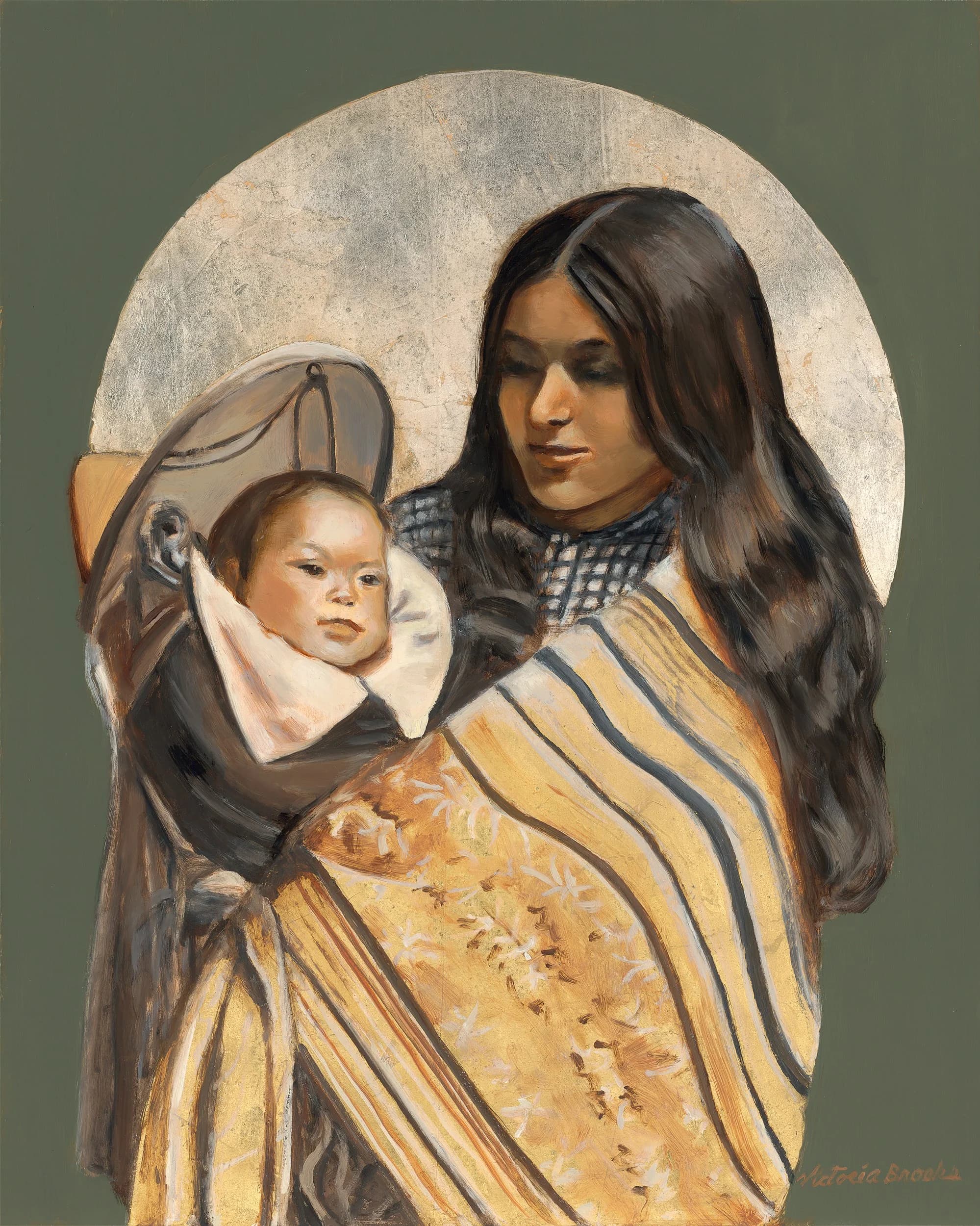
The photographer did not record her name. What follows is the history her photograph carries — offered as context, not biography.
The pairing in this painting — a woman with a baby laced into a cradleboard — appears constantly in photographs made between the 1880s and 1910s, from Edward S. Curtis's Apache images like 'Mizheh and babe' to anonymous stereographs sold as parlor entertainment. The cradleboard itself is one of the oldest and most widespread pieces of Native technology: a protective frame of wood or basketry, made in distinct forms by Ojibwe, Kiowa, Comanche, Apache, Diné, Hopi, Haudenosaunee, and many other peoples. It kept an infant's head and spine safe, and it kept the baby upright and present — riding along, watching the world, part of everything.
A cradleboard was rarely the mother's work alone. It was often the first gift made for a child — a frame carved by a father or grandfather, the wrappings, beadwork, and quillwork done by grandmothers, aunts, and other female relatives — so that before a baby could speak, they were already held by a web of kin. Many communities marked the first placement in the cradle with prayers and blessings, and boards were treasured and passed on. The decoration was not ornament for its own sake: it announced a family's love and a clan's joy at a new member.
The photographs rarely honored any of that. Captions ran to 'Indian mother and child' at best and collector's language at worst — turning a family into a curio. Because no single source print can be confirmed for this painting, it does not borrow one nation's design; it holds to what the camera truly witnessed in every version of this image: a mother steadying her child, and a child riding secure in equipment made with love. The names are gone. The bond was never anonymous to the two people inside it.