Apsáalooke (Crow)
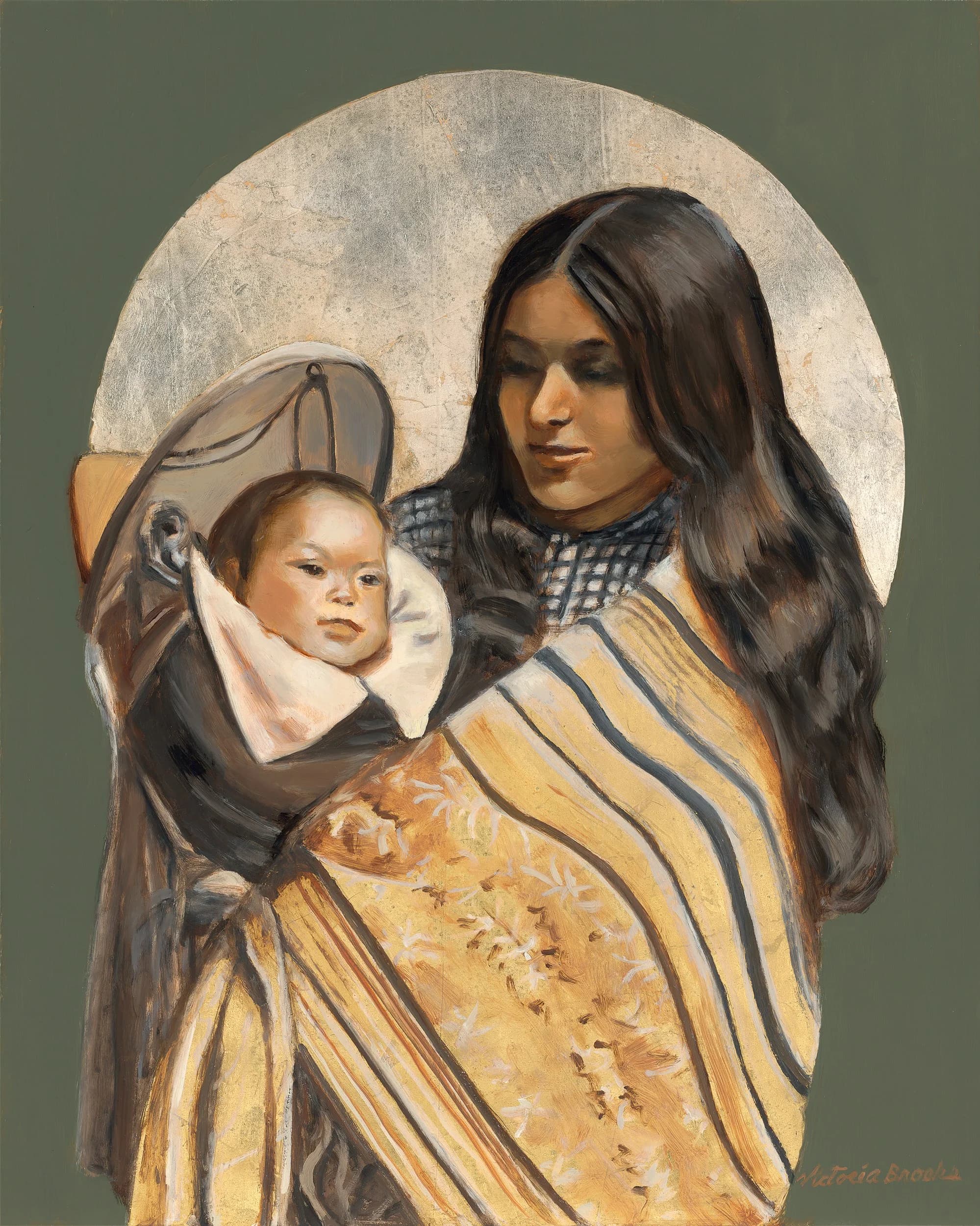
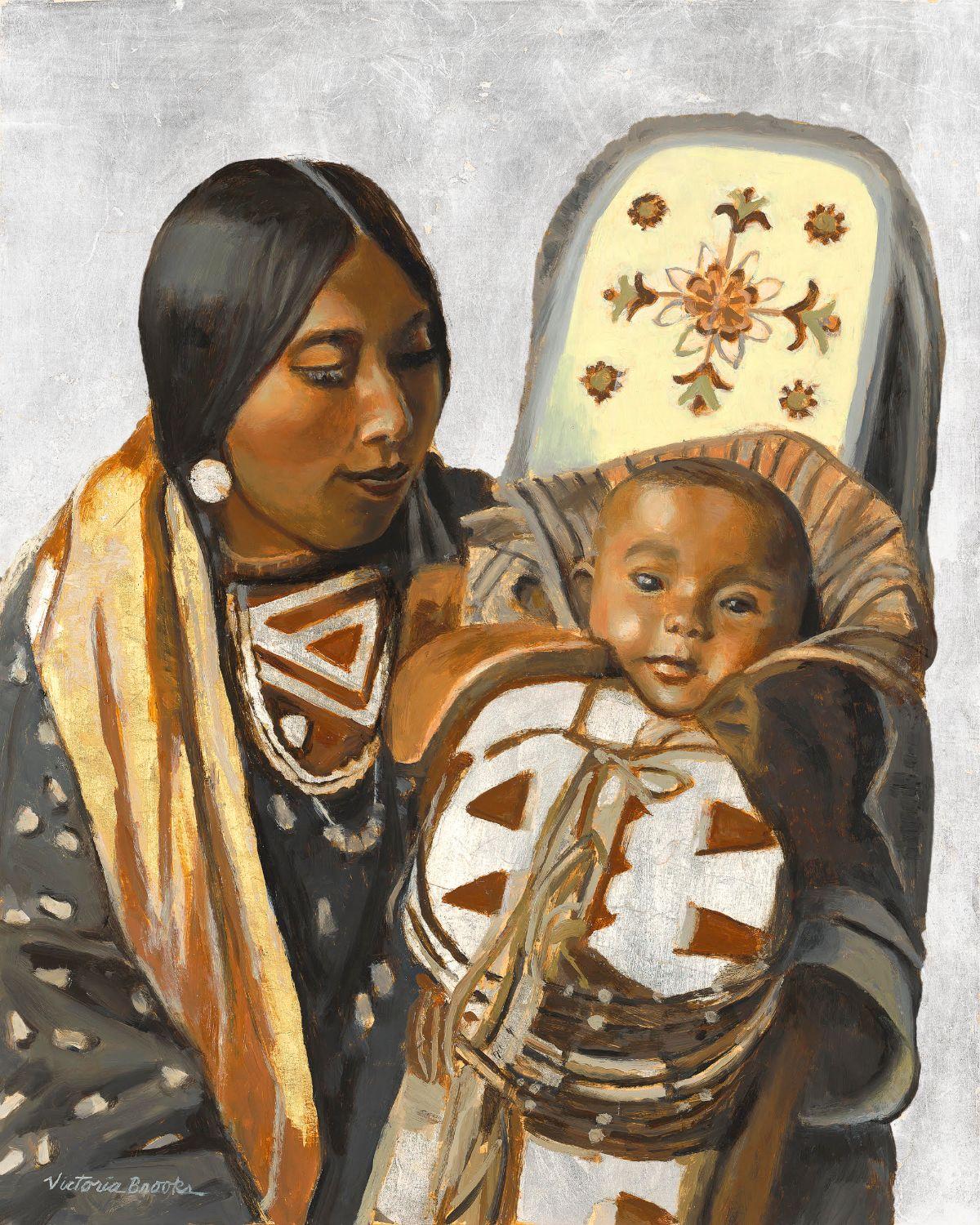
Crow Mother and Child
The photographer did not record her name. What follows is the history her photograph carries — offered as context, not biography.
The photograph behind this painting is a Curtis photogravure titled “Mother and Child – Apsaroke,” printed facing page 178 of Volume 4 of The North American Indian, the volume on the Apsaroke (Crows) and Hidatsa published in 1909. The plate carries the line “From Copyright Photograph 1908 by E. S. Curtis.” The caption names her people but not the woman or the baby, and neither the Northwestern University Libraries record for its complete set nor the Library of Congress copyright print identifies them. Apsaroke is Curtis's spelling; the nation writes its own name Apsáalooke. Who this mother was, and who her child grew up to be, are not in the record.
The print shows a young woman seated beside her child, her head turned down toward the baby. Her hair is parted in the center and falls smooth; a round shell disk hangs at her ear. She wears a dark cloth dress set with rows of elk teeth, a patterned shawl over one shoulder, strands of beads, and a banded collar of chevron beadwork. The baby, wrapped in plaid cloth, looks out toward the camera from a laced cradle. Above the child rises the cradle's rounded headboard, its pale beaded field worked with floral rosettes; below, the hide cover carries bold beaded triangles.
That cradle is a distinctly Crow form. Museum records describe the Apsáalooke cradle as a board wider at the top than the bottom, covered with stretched hide that forms a pouch in front, with beaded panels and tie straps; by custom it was made for an expectant family by the father's mother or sister. A Crow cradle at the Nelson-Atkins Museum of Art, dated about 1880, combines wood, native-tanned leather, glass beads and cotton cloth, the same materials visible here. PieceWork magazine, describing a Crow cradle Curtis photographed in 1908, identifies its beadwork as lane stitch, beads sewn down in parallel rows.
When Curtis worked among the Apsáalooke in the years up to 1908, their reservation in south-central Montana had been cut by acts of Congress in 1882, 1891 and 1904, the last leaving about 2.3 million acres of the eight million set by the 1868 Fort Laramie Treaty. The agency had stood at Crow Agency on the Little Bighorn since 1884. Government and mission schools operated at Crow Agency, St. Xavier, Pryor and Lodge Grass, and the first Crow Fair was held in 1903. Through those years, families went on making cradles like this one for each new child.
The Photograph
- Photographer
- Edward S. Curtis
- Year
- 1908 (published 1909)
- Collection
- “Mother and Child – Apsaroke,” The North American Indian, Vol. 4, photogravure facing page 178 — Northwestern University Libraries; 1908 copyright print at the Library of Congress
Bound-volume photogravure by John Andrew & Son, lettered “From Copyright Photograph 1908 by E. S. Curtis.” Curtis's caption does not name the woman or the child. Not to be confused with “Apsaroke Mother” (Vol. 4, facing page 24).
Sources & further reading (4)
- https://api.dc.library.northwestern.edu/api/v2/works/31b819f8-4ba9-4cb6-b395-85f45827a2a7
- https://art.nelson-atkins.org/objects/19502/cradleboard
- https://pieceworkmagazine.com/carrying-and-protecting-little-ones-native-american-cradleboards/
- https://opi.mt.gov/Portals/182/Page%20Files/Indian%20Education/Social%20Studies/K-12%20Resources/Crow%20Timeline.pdf