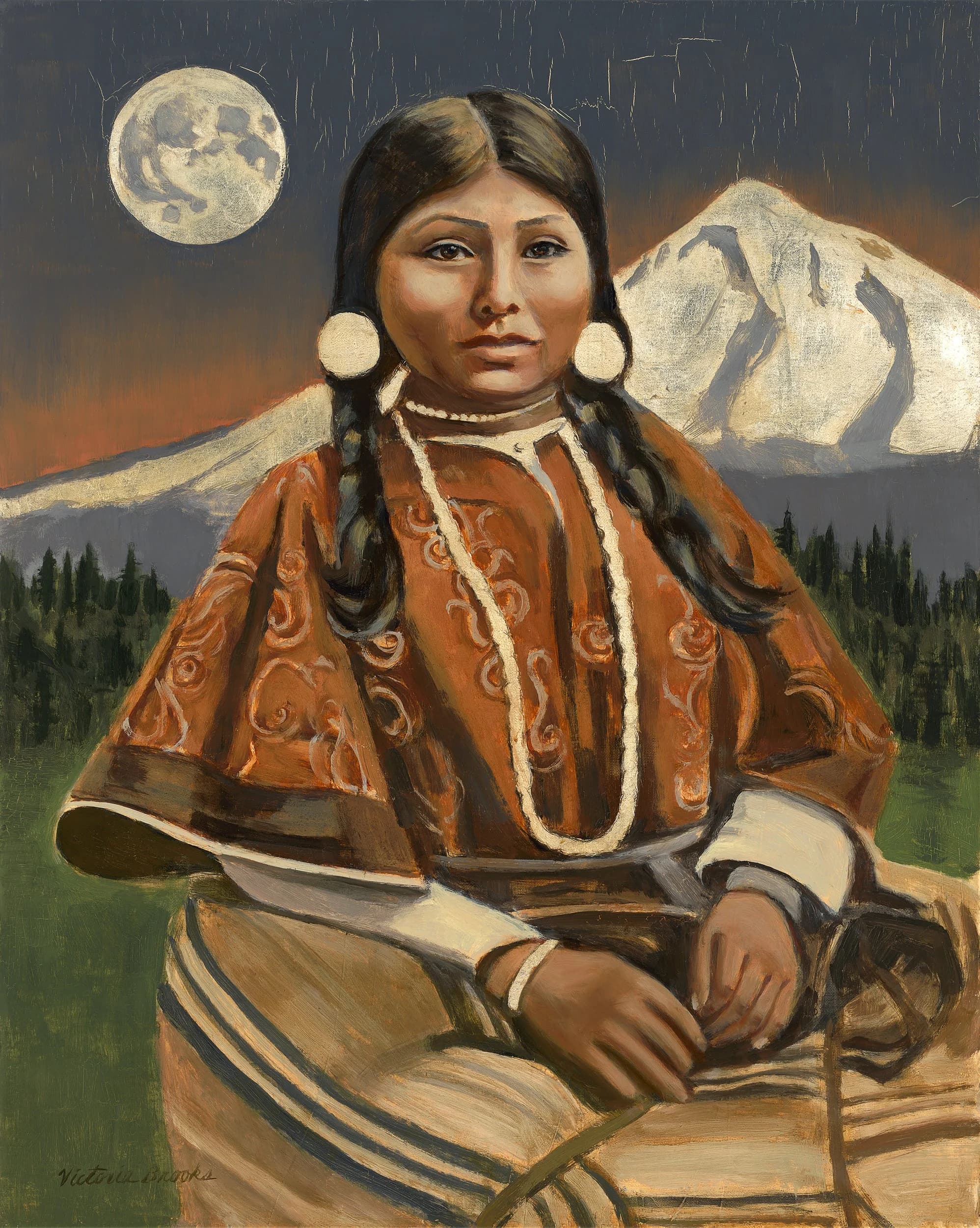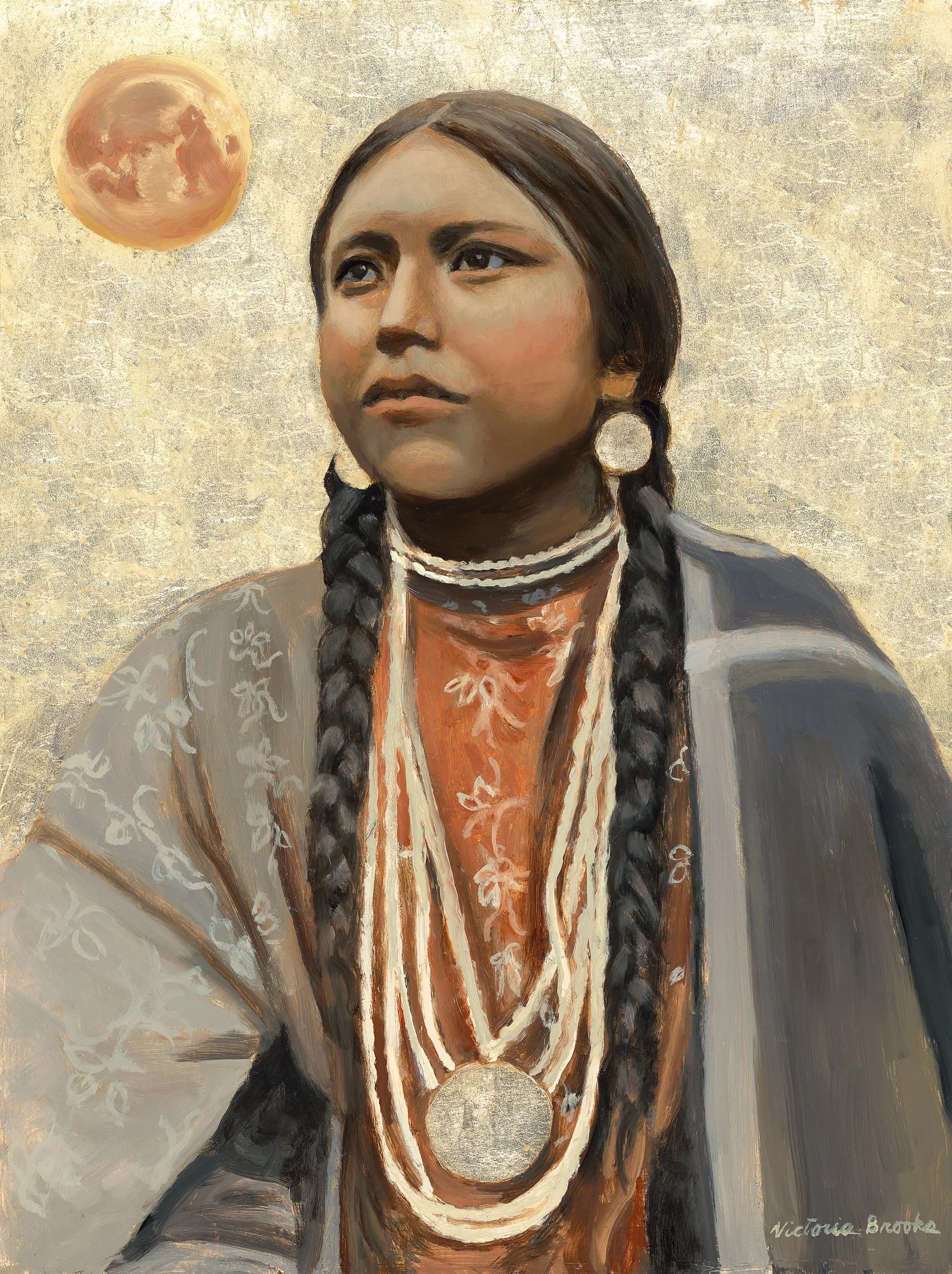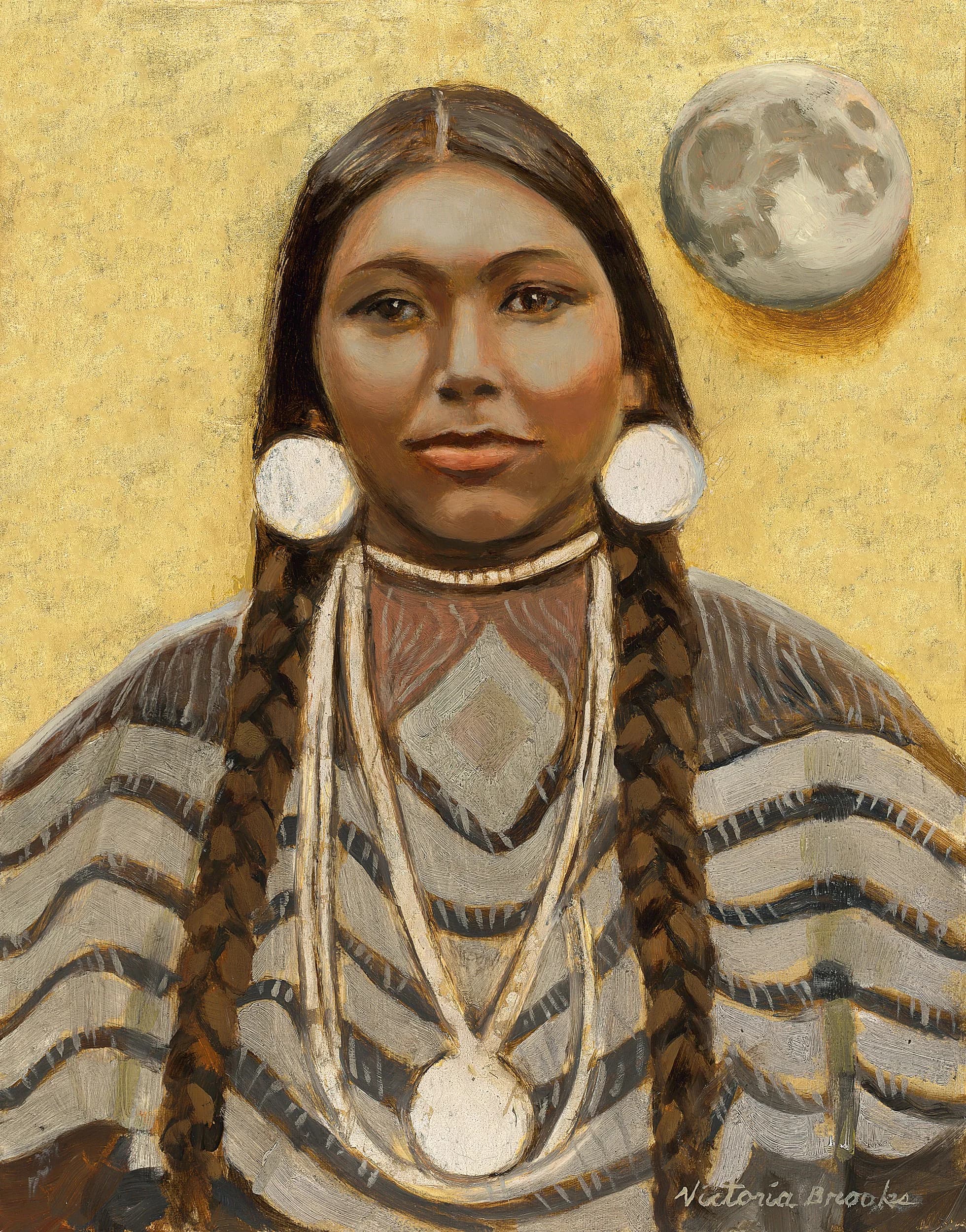
Possibly Yakama or another Sahaptin-speaking Plateau people
Estelle Speel-ye
Painted as “Estelle Speel-ye aka Stell Walking Antelope”
The photographer did not record her name. What follows is the history her photograph carries — offered as context, not biography.
This painting carries the name its source photograph carries: Estelle Speel-ye, called Stell Walking Antelope. The name itself points toward the Columbia Plateau — Speel-ye echoes Spilyáy, Coyote, the central figure of Sahaptin-speaking oral tradition among the Yakama and their neighbors — while Walking Antelope has the shape of a translated family name. But a careful search of the likely repositories — the Lee Moorhouse collection at the University of Oregon, the Plateau Peoples' Web Portal maintained with the region's tribes, and the Library of Congress and Smithsonian catalogs — did not surface an institutional record of either the photograph or the woman, under any spelling tried.
That silence is itself historical. Studio and agency photographers worked throughout Yakama and Plateau country from the 1890s onward, and their negatives scattered into collections that recorded titles like “Indian girl” far more often than names. Names that did survive often did so outside institutions — penciled on the back of a print, remembered in families, passed along with copies — which is likely how this one traveled.
Until documentation catches up with the picture, the honest account is this: she was a real woman, most plausibly of the Yakama or another Sahaptin-speaking Plateau nation, photographed in the formal portrait style of the 1890s–1910s, and her name — unlike thousands of others — at least survived the journey. Verification would best come from the Yakama Nation Museum in Toppenish and from Plateau families themselves, whose photo registrars and elders hold knowledge the databases do not. If that community can restore her story, this account should be rewritten around it; nothing would honor the portrait more.
The Photograph
- Photographer
- Unrecorded
- Year
- c. 1890s–1910s (stylistic dating)
- Collection
- No institutional record located — searched the Lee Moorhouse collection, the Plateau Peoples' Web Portal, Library of Congress and Smithsonian catalogs
The name survives only as it travels with the circulating photograph.