Tohono O'odham (Papago)
Luzi
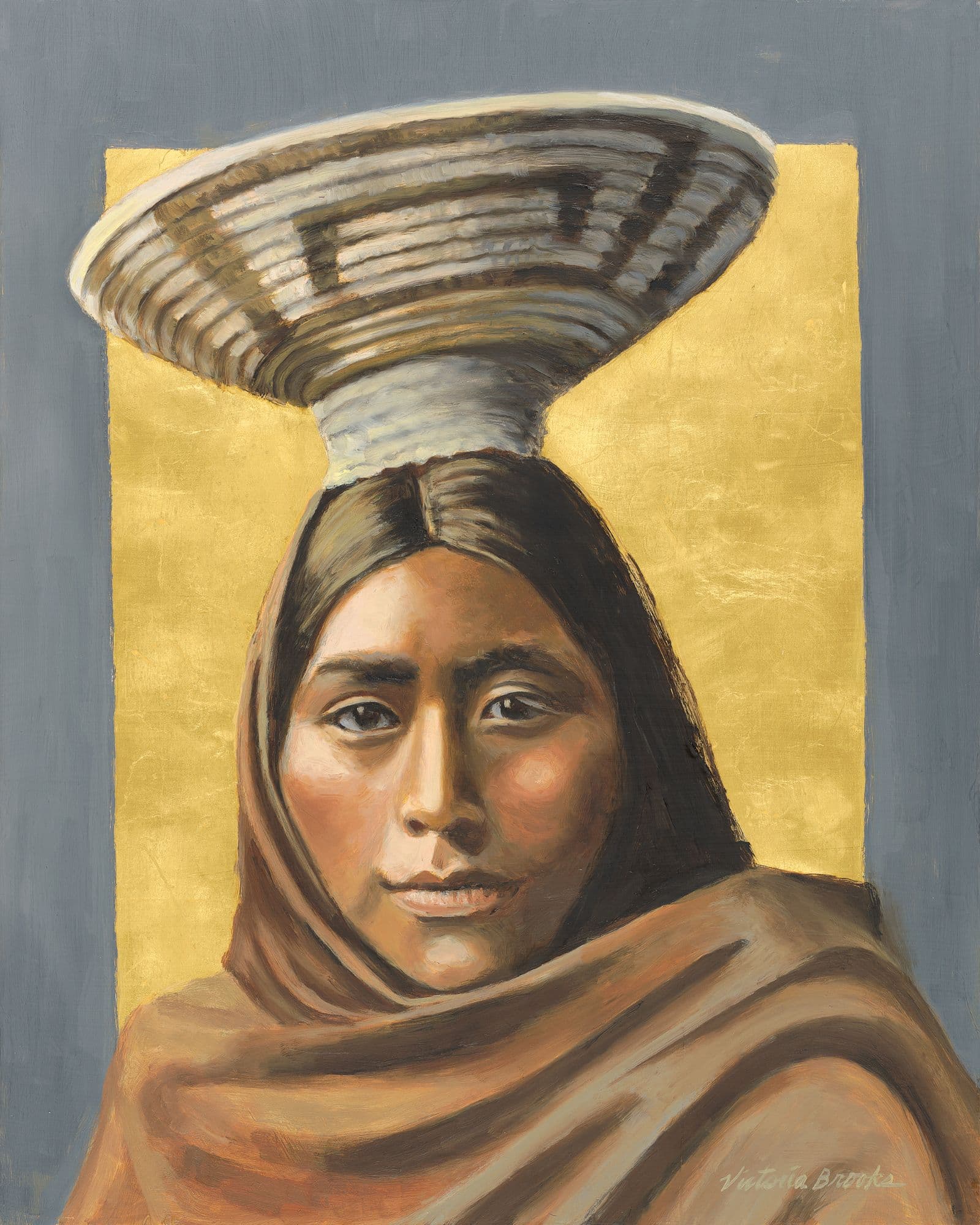
Painted as “Luzi - Papago”
In 1907 Edward S. Curtis photographed a young Tohono O'odham woman with a shallow coiled basket tray on her head, resting — as his caption explains was the O'odham way with flat-bottomed loads — on a ring of woven yucca. He recorded her name: Lúzi. The negative, Curtis number 2291-07, was copyrighted that year and published in 1908 as plate 53 of Portfolio 2 of The North American Indian, the part of Curtis's project covering the desert peoples of southern Arizona. A large photogravure printed in brown ink by John Andrew & Son survives at Northwestern University, and the Library of Congress holds a photographic print in its Edward S. Curtis Collection.
Most plates in that portfolio name no one — Papago Girl, Papago Matron, A Papago. Lúzi is one of only a few O'odham sitters whose personal name went to press with her picture, alongside Hókak and the chief Carlos Rios. Her name is nearly all the record holds: the catalogs give no age, no village, no family, and the Library of Congress lists her simply under the subject heading Luzi. What the photograph itself shows is concrete — a young woman looking straight into the lens, practiced at a way of carrying that O'odham women used daily for baskets, pottery, and boxes, the woven ring seating the load and easing its weight.
The tray she carries belongs to a craft worked by O'odham women across the Sonoran Desert: baskets coiled from bundles of beargrass and sewn over with willow or yucca, the black patterning cut from the pods of devil's claw. When Curtis passed through in 1907, only two O'odham reservations existed — San Xavier, established south of Tucson in 1874 around the mission village of Wa:k, and Gila Bend, added in 1882; the large reservation centered at Sells followed in 1916. The word on the plate, Papago, was an outsiders' name. In 1986 the nation's new constitution replaced it with Tohono O'odham — Desert People — the name its citizens use today.
The Photograph
- Photographer
- Edward S. Curtis
- Year
- 1907 (published 1908)
- Collection
- The North American Indian, Portfolio 2, plate 53 — Library of Congress, Edward S. Curtis Collection; Charles Deering McCormick Library, Northwestern University
Curtis negative 2291-07; photogravure printed in brown ink by John Andrew & Son, Boston. Curtis's caption describes how O'odham women carried flat-bottomed loads on a ring of woven yucca placed on the head.