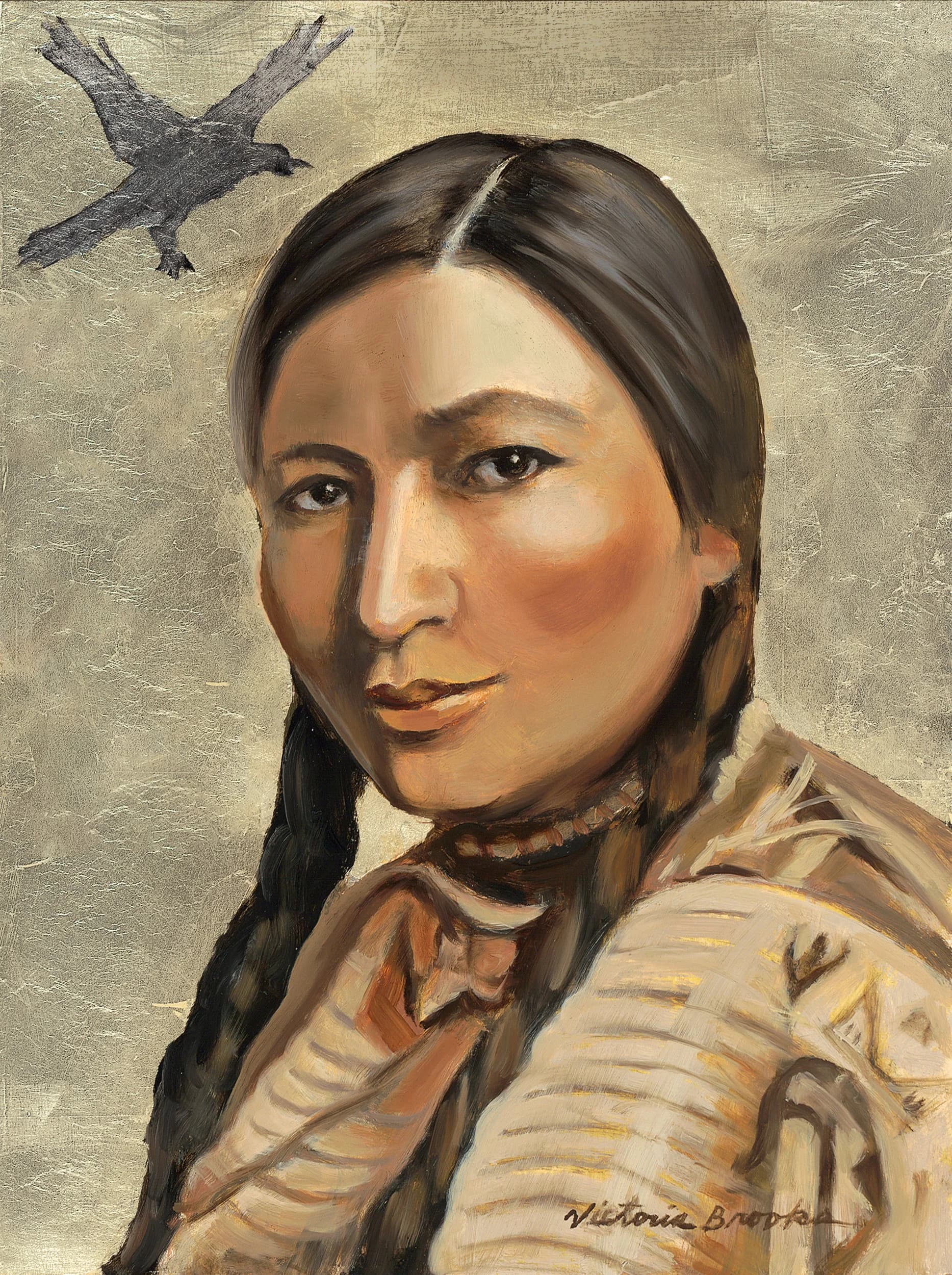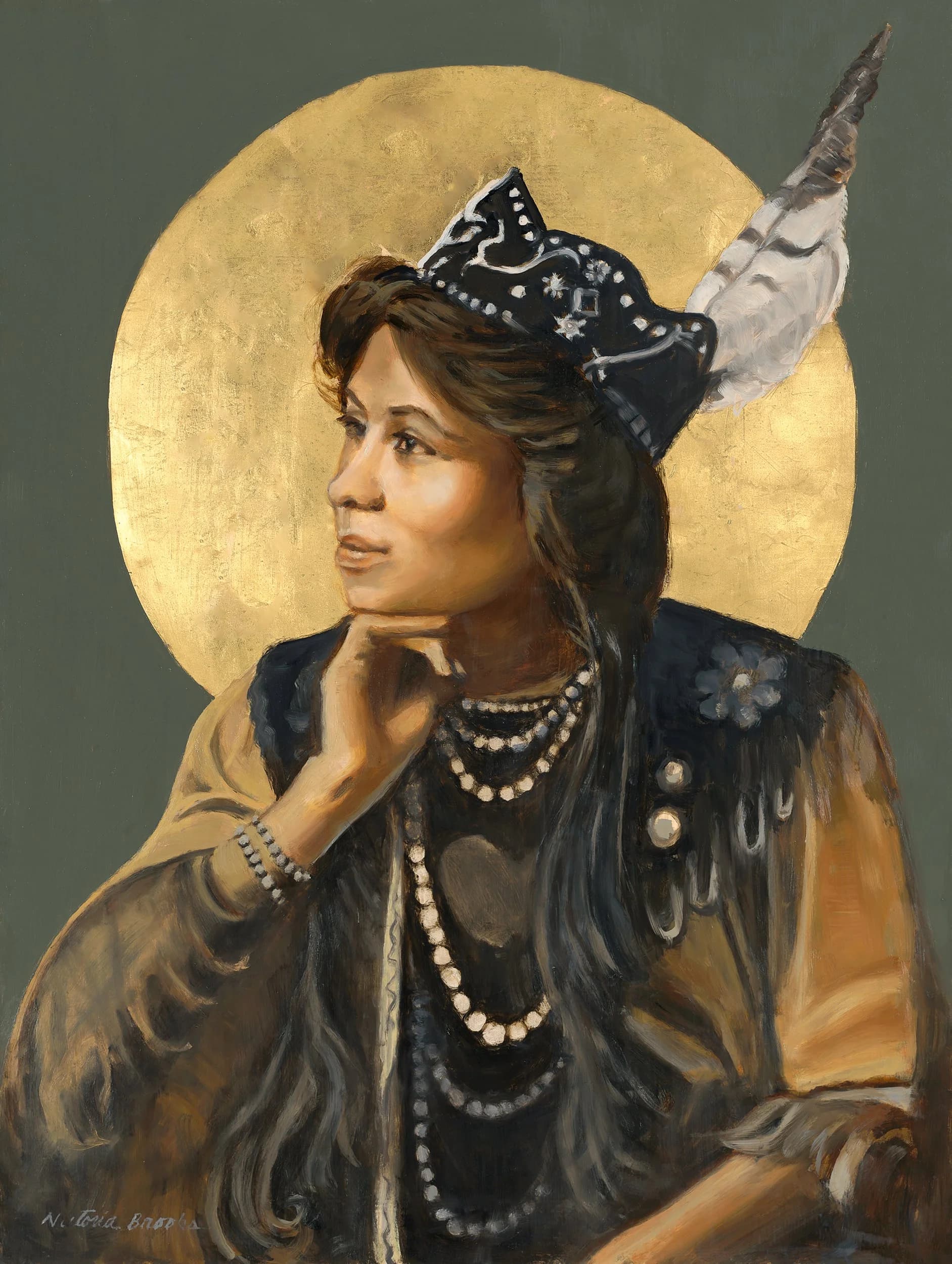
Muscogee (Creek) Nation, with Cherokee ancestry
Tsianina Redfeather Blackstone
Painted as “Tsianina Redfeather”
1882 – 1985
Tsianina Redfeather was born Florence Tsianina Evans on December 13, 1882, in Eufaula, in the Muscogee Nation of Indian Territory — a citizen of the Muscogee (Creek) Nation with Cherokee ancestry. Her musical gift was recognized early: at fourteen she was sent to Denver to train, her studies sponsored in part by Alice Robertson and carried forward on scholarships in Denver and New York. She became a mezzo-soprano of unusual warmth, and in Denver she met the composer Charles Wakefield Cadman — the partnership that would carry her voice across two continents.
From her mid-twenties she toured with Cadman, singing his songs — “From the Land of the Sky-Blue Water” became her signature — in concert halls from the American symphony circuit to the capitals of Europe. Promoters billed her as “Princess Tsianina Redfeather,” a concert-circuit invention of the kind the era pinned on Native women; her artistry needed no title. Cadman's opera Shanewis (The Robin Woman), drawn from her own semi-autobiographical stories, premiered at the Metropolitan Opera in 1918 to twenty-two curtain calls, and Tsianina herself sang the title role in Denver in 1924 and at the Hollywood Bowl in 1926. In 1918 she led a YMCA-sponsored troupe of Native American entertainers through wartime France and into Germany, honored by General Pershing — and remembered as the first woman to cross the Rhine to reach American troops.
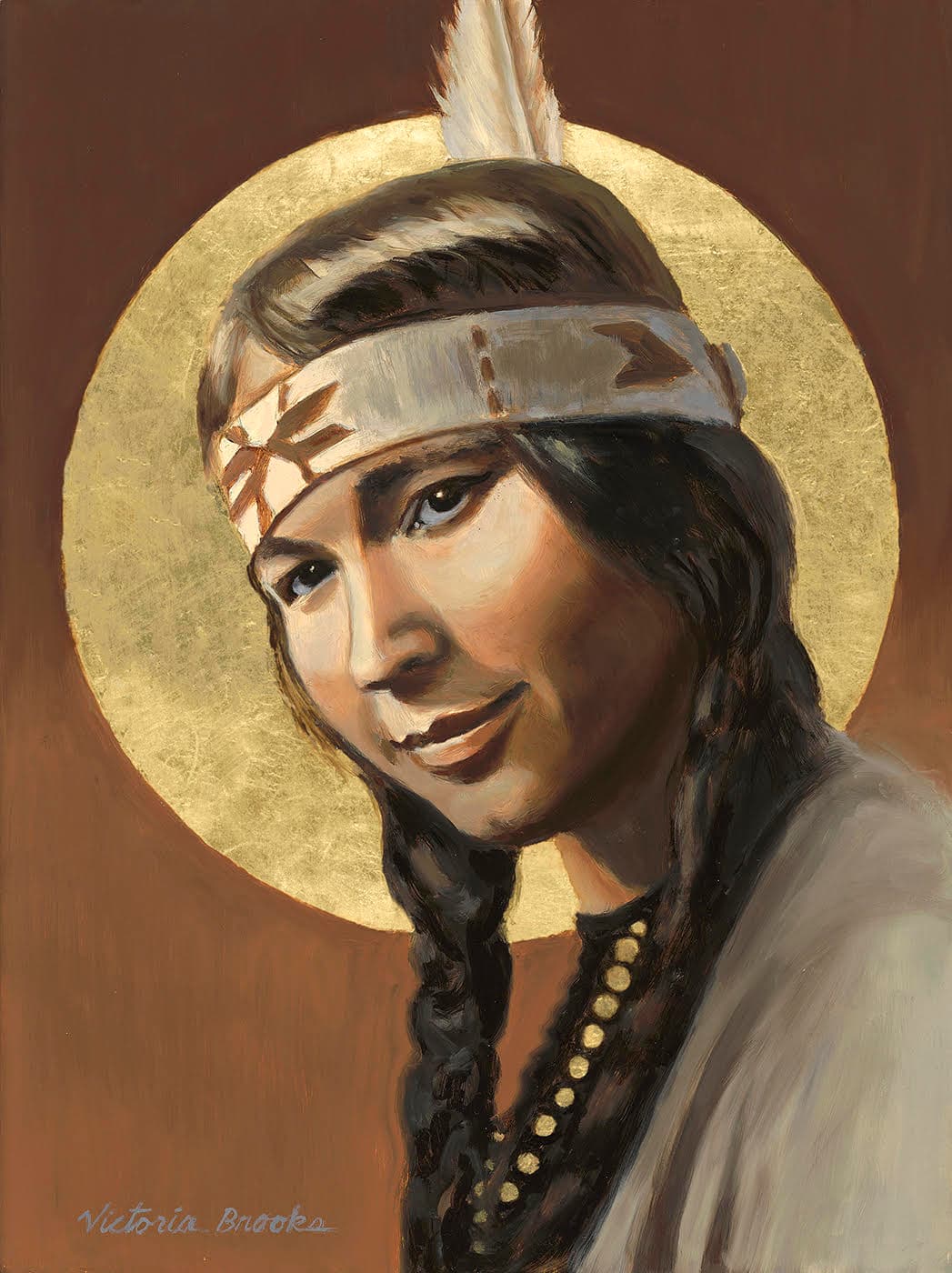
Her second act was as remarkable as her first. Retiring from the stage in 1935, she co-founded the American Indian Education Foundation, served thirty years on the board of the School of American Research in Santa Fe, founded the First Daughters of America, and quietly paid for the schooling of Muscogee children from her own purse. She told her story in a 1968 autobiography, Where Trails Have Lead Me, and died in San Diego on January 10, 1985, at 102. Victoria paints her at thirty-eight, at the height of her fame — the gold leaf behind her a fitting ground for a woman who turned every stage she was given into her own.
The Photograph
- Photographer
- Unrecorded (concert-era studio portrait)
- Year
- 1920
- Collection
- Concert and publicity photographs of Tsianina survive from throughout her performing years, 1915–1925
Painted from a photograph made when she was thirty-eight, wearing the beaded headband and single feather of her concert regalia. The photographer of the 1920 sitting was not recorded with the circulating print.