Kwakwaka'wakw — born at Tsaxis (Fort Rupert), British Columbia; K'ómoks by marriage
Margaret Elizabeth Frank
Painted as “Kwakwaka’wakw aka Margaret Frank”
b. December 17, 1897
Margaret Elizabeth Frank, née Wilson, was born on December 17, 1897 at Tsaxis — Fort Rupert — on the northern coast of Vancouver Island. Her mother was Emily Hunt Wilson, placing her inside the remarkable Hunt family of the Kwakwaka'wakw world; scholars who restored the Curtis film identify Margaret as a granddaughter of George Hunt, the ethnographer who anchored both Franz Boas's and Edward Curtis's Kwakwaka'wakw work. The Kwakiutl Band Council's elders' history records her Kwak'wala name as Ou-ma-ge-lis.
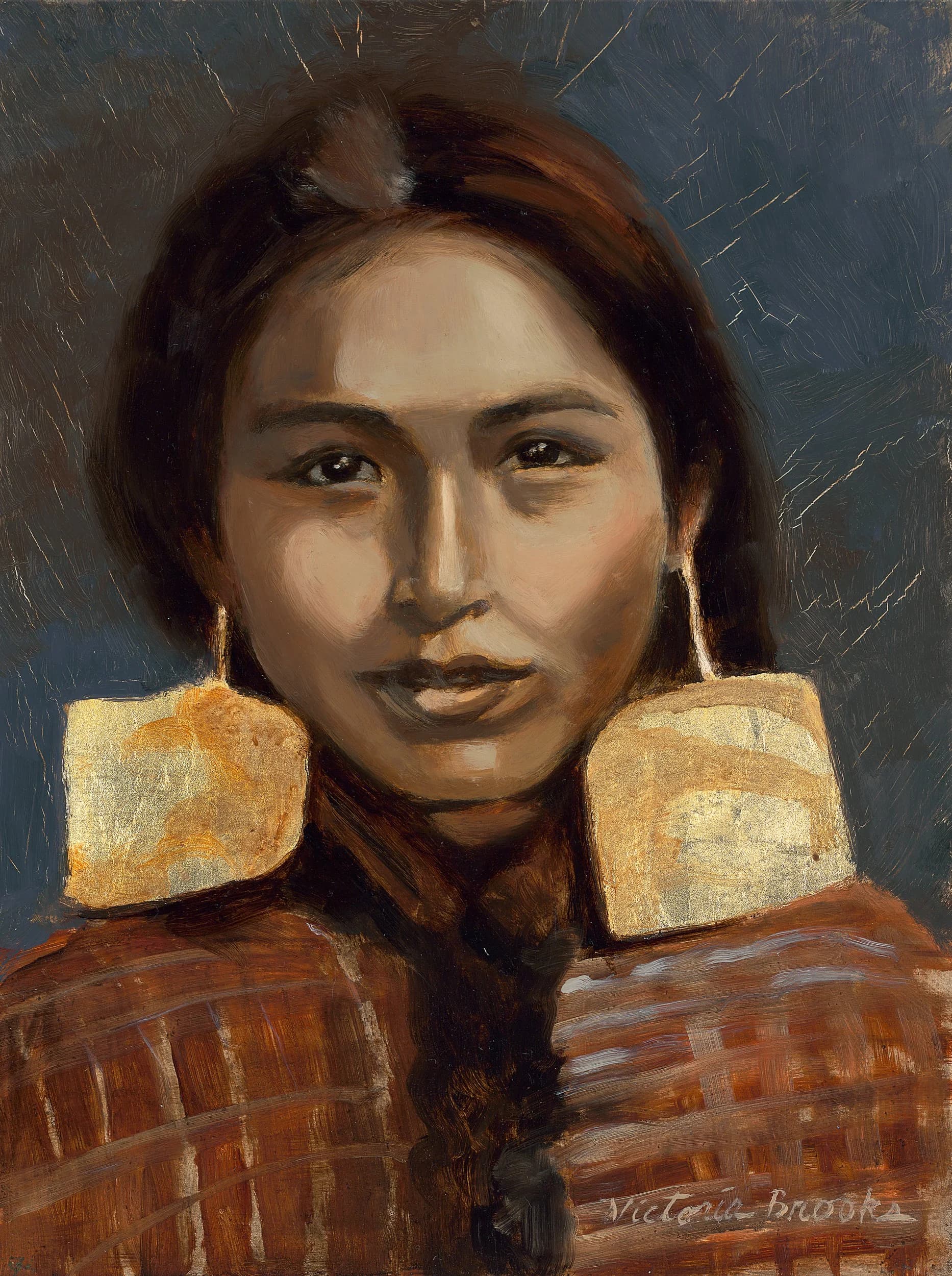
In 1914, at seventeen, she played Naida, the chief's daughter and female lead, in Curtis's In the Land of the Head Hunters — often described as the first feature film with an entirely Indigenous cast, made with Hunt family relatives who built its sets, props and regalia. From the same year comes the famous portrait Curtis published as “A Tsawatenok Girl”: Margaret wrapped in a fur-lined cedar-bark cape, wearing large abalone-shell ear pendants. Among Kwakwaka'wakw people abalone was wealth made visible, worn as a sign of noble rank; the iridescent shells announced exactly who she was.
Her life after the cameras was long and consequential. By the band council's account she became the first Native woman to work at the hospital in Alert Bay. In the late 1920s she met Andy Frank of the K'ómoks First Nation; they married, and she brought to Comox the songs, dances and hereditary privileges she carried from Fort Rupert. Chief Andy Frank built a bighouse to meet the expectations of her dowry, and the couple potlatched at Fort Rupert and Comox through the decades when Canadian law still banned the potlatch. Elders' accounts say she held all the traditional songs, titles and dances, and was exacting about their rightful use.
Her descendants keep her present on the same coast: her daughter Mary Everson and her grandson, the K'ómoks artist Andy Everson, trace their teachings directly to Margaret and Chief Andy Frank. A century after Curtis left his sitter generic, anthropologists and Kwakwaka'wakw family memory have restored her name to the image.
The Photograph
- Photographer
- Edward S. Curtis
- Year
- 1914
- Collection
- The North American Indian, vol. 10 (1915); Library of Congress Edward S. Curtis Collection
Curtis published her confirmed portrait — cedar-bark cape, abalone-shell ear pendants — as “A Tsawatenok Girl.” Margaret's name attaches to Curtis's “chief's daughter” imagery because she played the chief's daughter, Naida, in his 1914 film.